RSS Feed

Soft butternut squash cakes

I’ve been more focused on toddler-friendly meals lately, natural since Nicholas is getting bigger, but I don’t want to stop experimenting with recipes that are also good for your smaller little ones.

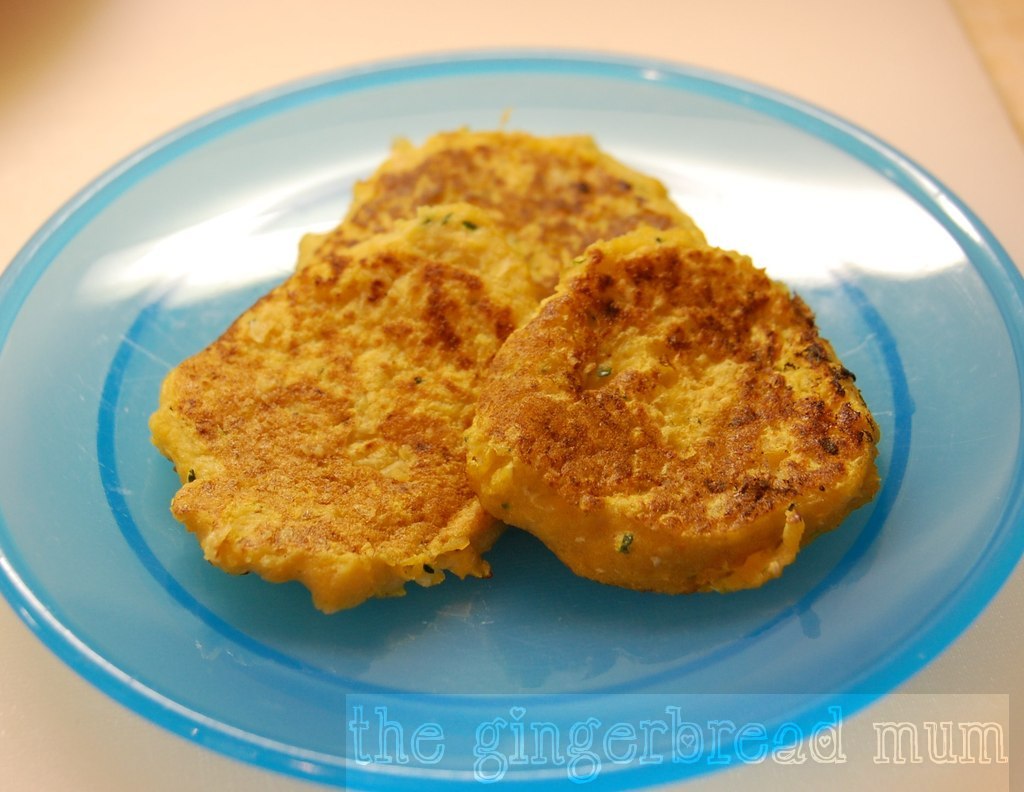
These little vegetable cakes are very soft inside so great for babies without teeth. They are a simpler (and slightly quicker) version of my Butternut Squash and Chickpea Cakes, which are easily adapted to feed the whole family.

I made some medium and small-sized ones, but because of their softness the small ones (about 4cm in diameter) are easier for small fingers to hold and also easier to flip over when you’re cooking them.

If you’re making these for toddlers you can add some seasoning and also some spice (I used a teaspoon each of paprika and cumin for a warming spicy flavour). If you’re introducing a little spice to your munchkin, start with 1/2 teaspoon each of spices.

Use your preferred method of cooking the butternut squash, remembering that the quicker you cook it, the more nutrients remain. For toddlers you can leave the peel on as it will get chopped up in the food processor when you combine it with the other ingredients.

This recipe makes a large batch of cakes – perfect to have in the freezer for days you don’t feel like cooking.
SOFT BUTTERNUT SQUASH CAKES

Prep time: 10 mins
Cook time: 15 mins
Makes about 40 mini cakes (or 26 medium cakes)
Freezable

Approx. 400g cooked butternut squash
1 medium courgette (zucchini), coursely grated
1 400g can chickpeas, rinsed and drained
1 egg yolk
1/2 cup plain flour
Drizzle of olive oil or cooking spray

For toddler version also:
1 tsp paprika
1 tsp cumin
Salt and pepper

Put the butternut squash into a food processor and blend until smooth. If you’ve left the skin on, check that it’s broken up into small pieces.

Add the grated courgette, chickpeas, egg yolk and flour. Blend until combined (the mixture will be quite runny almost like a pancake mixture).

If making for a toddler, add the paprika, cumin and season to taste.

Heat a large non-stick frying pan over a med-low heat, spray with cooking spray or use a drizzle of olive oil.

Drop small spoonfuls of mixture into the pan (don’t overcrowd the pan to make turning them easier), flipping them after a few minutes when they’re golden brown and cooking the other side. Repeat with the remaining mixture.

Leave to cool a little (they’ll firm up a bit as they get cooler). Serve with yogurt to dip them into.

Variations:

  • Use sweet potato instead of butternut squash
  • For toddlers, try some different spices such as ground coriander
  • Add some fresh coriander to the mixture

What other soft foods do you like to make for your little ones, especially when they don’t yet have teeth?

Back to business as normal

A few of you emailed me last Thursday asking where my blog had gone. All you could see was a notice from WordPress saying their terms had been violated and so the blog had been suspended.

While I was waiting for WordPress to review the situation, I was going ‘AH!’, and scouring their terms and conditions for any possible unintentional wrongdoing on my part. Why is it we always feel guilty even if we haven’t done anything wrong? Or is that just me?!

Anyway, to cut the story short, I hadn’t done anything wrong. For some reason something triggered their automated anti-spam controls. I’ve been assured it won’t happen again and received an apology. While I wasn’t told what exactly triggered the suspension, at least we’re back to business again, and I can finish writing the recipe post I was working on!

Completely changing the subject to something much nicer, we went away for the weekend and enjoyed some wonderful family time together. Roberto did the driving experience I got him for Christmas, and had great fun trying a Ferrari and a Lamborghini. And we ate our way through the East Midlands Food and Drink Festival in Melton Mowbray.

Big Questions from Little People – book review

So your child asks, ‘Are we all related?’ What do you say?

I’m already thinking about the difficult and awkward questions that Nicholas undoubtedly will ask in the not too distant future, and wondering what I’ll do. Will I pretend to be an expert on all matters? Will I pass the job over to hubby, who always gets more questions right when we watch University Challenge? Will I concede that I don’t know everything and teach Nicholas how to use Wikipedia?

Imagine if you could ask Dr Richard Dawkins to help you out (“Let’s give Uncle Dick a call. He’ll know!”).  But then if I think about how many ‘why…?’ questions I’ve heard from nieces and nephews over the years, and think of all the different subjects they’ve asked about, I’d need a huge array of expert ‘phone a friend’ lifelines!

Fear not, Gemma Elwin Harris has come to our aid. Inspired by her own son’s and nieces’ questions, Gemma came up with the brilliant idea to get the best possible answers from the UK’s most knowledgeable experts to more than 100 real questions from primary school children, aged from 4 to 12. So Sir David Attenborough answers ‘Are there any undiscovered animals?’, Heston Blumenthal answers ‘Why do we cook food?’, and Professors Chris Stringer, Gary Marcus and Michael Rosen all answer the extremely tricky ‘What makes me me?’.

‘Big Questions from Little People… Answered by Some Very Big People’ covers a vast range of subjects, from bodily functions to space, from food to sport, from animals to history, from music to philosophy. The brilliant experts include Noam Chomsky, Sister Wendy, Tracey Emin, David Crystal, Jessica Ennis, Philip Pullman, Annabel Karmel, Derren Brown and Bear Grylls.

It seems as if all the experts have tried to write their answers using language a child could understand, but of course some subjects are easier to understand than others. Quite a few, but not all, of the experts clearly answer the question in the first sentence or first paragraph and then go on to further explain it. It perhaps would have been good for them all to answer in this way, even having the concise answer clearly separated from the rest of the text, so even young children get a clear answer while older children can read more about the topic.

The font is a good size for children and there are some black and white illustrations throughout, breaking up the text. The book has a thorough index at the back, making it easy to find the answers you need, all the questions are listed in the contents with the corresponding expert, and you can also read more about each expert.

I love the fact that the questions are unedited (there’s the very cute ‘Why is space so sparkly?’ to the very bizarre ‘Did Alexander the Great like frogs?’). There are also some hilarious joke answers to the book’s questions at the end by comedians including Stephen Fry, Sandi Toksvig and Clive Anderson (Why are the grown-ups in charge? Because they got here first!).

But probably the best thing about ‘Big Questions…’ is that it’s in aid of the NSPCC, raising vital funds to help vulnerable children and young people across the UK and the Channel Islands. Over half of the advance and royalties from the book are going to the charity.

This is a brilliant book to buy for your children, a wonderfully different present for new parents or buy it just to support a great charity. I’m going to start seriously studying now, with the hope that by the time Nicholas starts asking me these types of questions I’ve memorised the answers and I’ll be Super Intelligent Mummy!

Published by Faber, ‘Big Questions from Little People’, is available from today from all good bookshops and selected supermarkets, and online from Waterstones and Amazon.

And by the way, the answer to the first question is yes, we’re all related.


Created by Faber and Faber for the book Big Questions From Little People. INFOGRAPHIC: What Big Questions are on Your Child’s Mind?

Disclosure: I was given a free copy to review; my opinions are my own. I made a donation to the NSPCC.

Vegetable Korma

I’ve talked before about not being very adventurous with spice in Nicholas’ food, but I’ve been trying to extend his tastebuds by adding different spicy flavours. Last week we went to our local pub for dinner and chose a mild chicken curry off their good children’s menu. When I tasted it I was surprised by the level of spiciness (closer to medium than mild), so was very curious to see Nicholas’ reaction. He loved it! Here’s to more spice then.

You can find some interesting and easy Indian-inspired baby and toddler recipes on the Homemade Baby Food Recipes site. My vegetable korma is a very slight adaptation of one they say you can give babies from 7 or 8 months (please use your discretion and your expert knowledge of your baby to decide when to introduce some aromatic spices to their food, and it’s always best to only introduce one new spice or food at a time).

This has a mild level of spiciness, more warming than hot, so perfect for even young tastebuds. Next time I’ll double the quantities of spice (so 1/4 tsp of each) and add some chopped or crushed garlic at the start for some more oomph.

You can really use any vegetables you have on hand for this korma. Sweet potato, green beans, bell peppers (capsicum), mushrooms and broccoli would all work well. Don’t worry too much about measuring exact quantities; trust your instinct to add more or less of each vegetable. It takes a bit more time, but cutting the vegetables into quite small pieces means they cook quicker and keep more of their nutrients.

Toddlers can eat the korma as is with some rice. For babies, blend the vegetables after it’s cooked or, if your munchkin is fine with some lumps, roughly mash it with a fork or potato masher.

VEGETABLE KORMA

Prep time: 10-15 mins
Cook time: 25 mins
Makes 3-4 toddler portions
Freezable

1 tbsp olive oil
1 small onion, finely diced
1 medium carrot, peeled and diced
1/2 cup cauliflower, chopped into small pieces
1/2 cup peas
1 medium potato, peeled and diced
1 tbsp unsweetened dessicated coconut
1 tbsp tomato puree
1 cup water
1/8 tsp (or a large pinch) ground ginger
1/8 tsp (or a large pinch) cumin
1/8 tsp (or a large pinch) turmeric
1/8 tsp (or a large pinch) ground coriander
Salt to taste (optional)

Heat the oil in a medium saucepan over a medium-low heat. Add the onion and carrot and cook for a few minutes until the onion is translucent and the carrot is starting to become softer.

Add the tomato puree and spices. Cook for 2 minutes, stirring continuously.

Add the remaining vegetables, coconut and water (and salt, if using). Stir, turn up the heat to medium-high and bring it to the boil.

Reduce the heat to low, cover and simmer for about 20 minutes until all the vegetables are cooked.

If serving to a baby, either blend the mixture until a smooth puree, or roughly mash with a fork or potato masher for a lumpier puree.

For a toddler, serve with cooked rice.

Variations:

  • Use different vegetables such as sweet potato, broccoli, bell peppers (capsicum), green beans or mushrooms.
  • Add chopped or crushed garlic to the onion and carrot.
  • Add grated fresh ginger to the onion and carrot.
  • Add a spoonful of coconut cream at the end.

Have you introduced spice to your little one’s food? Do they like it?

Happy grandparents’ day!

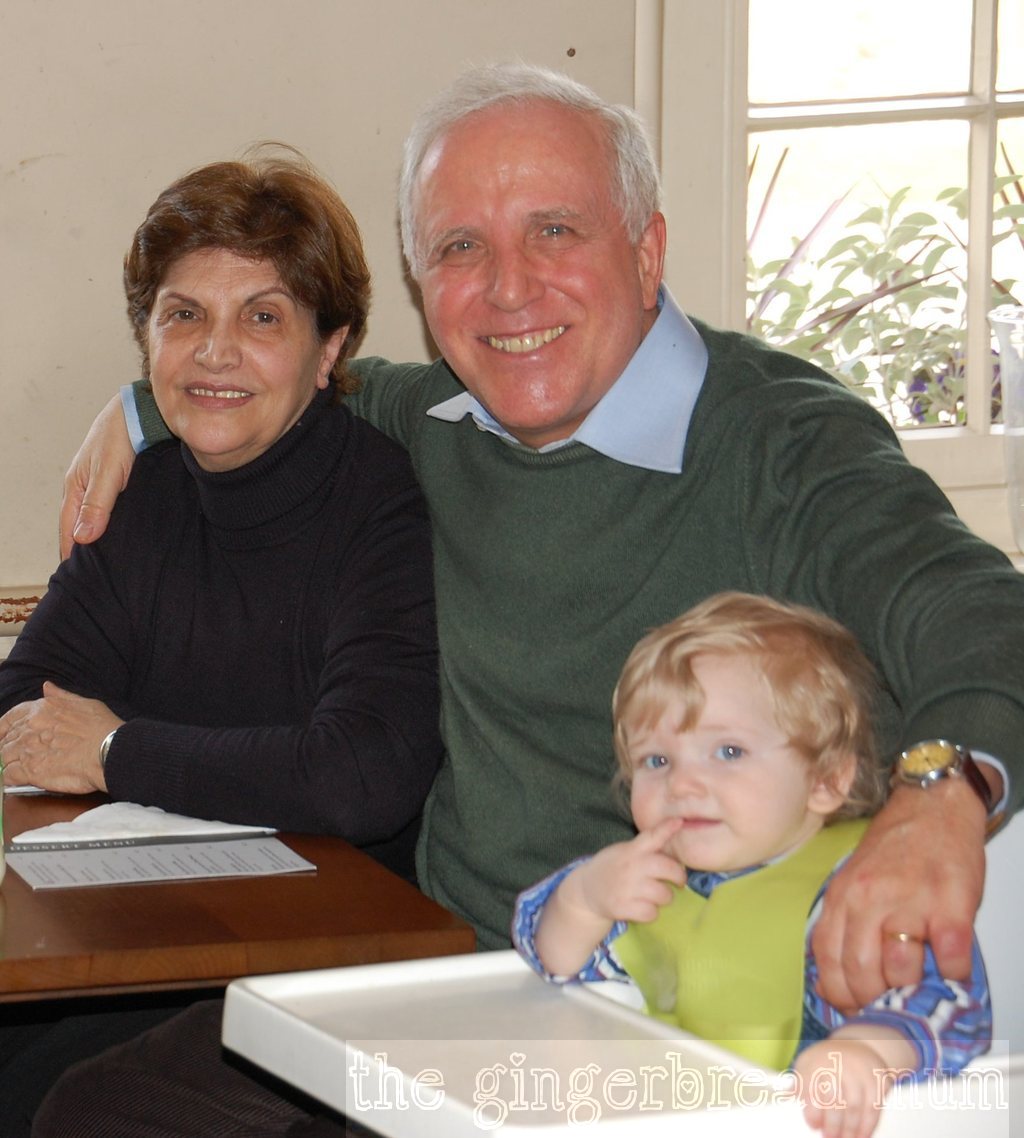
In Italy, today is ‘La Festa Dei Nonni’ (Grandparents’ Day) and so Nicholas wanted to say ‘AUGURI!’ to his very loved nonna and nonno by sharing a couple of mummy’s favourite photos.

Nobody can do for little children what grandparents do.
Grandparents sort of sprinkle stardust over the lives of little children.

~ Alex Haley


Blueberry pancakes (sugar-free)

Hubby and I are following the Dukan diet to lose the spare tyres that have appeared over the years helped by us loving food and really not liking exercise. So far it’s working well and hasn’t been too hard to follow (you have foods you can eat, and you can eat as much as you like of them, and foods you can’t eat). You also have to eat oatbran and it’s easier to eat this in the morning (it also keeps your tummy full until lunchtime). I make Dukan’s galettes which always smell divine because of the cinnamon and vanilla I put in, but they taste very similar to cardboard!

Nicholas sees us eating our galettes and, of course, wants some too. For the moment he doesn’t realise that his galettes are usually banana pikelets or apple pikelets. My stocks in the freezer of these were running low so I thought I’d try a new flavour – blueberry.

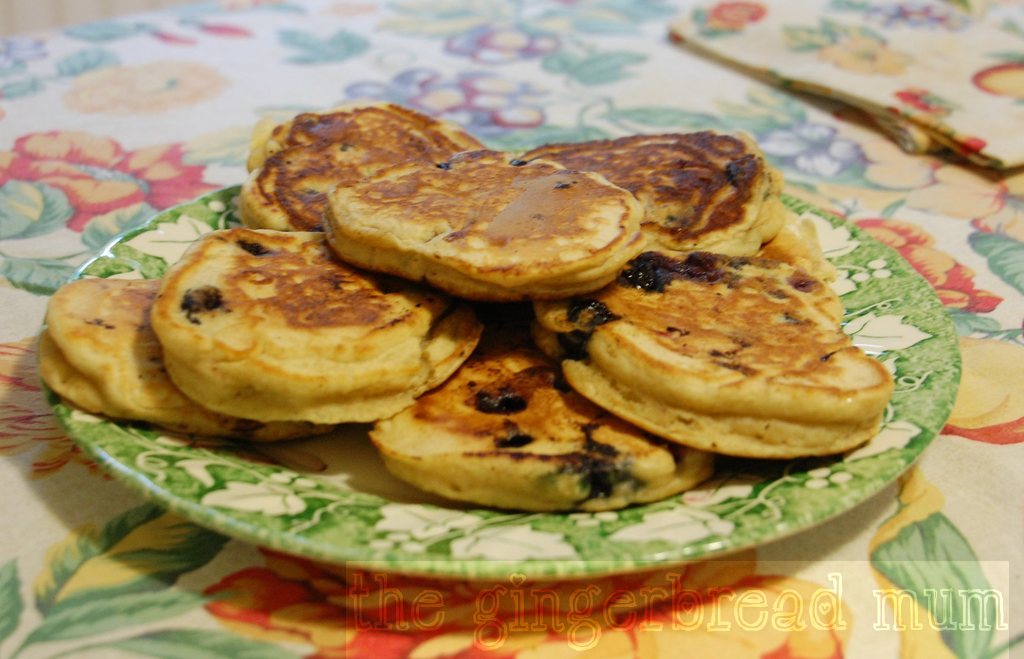
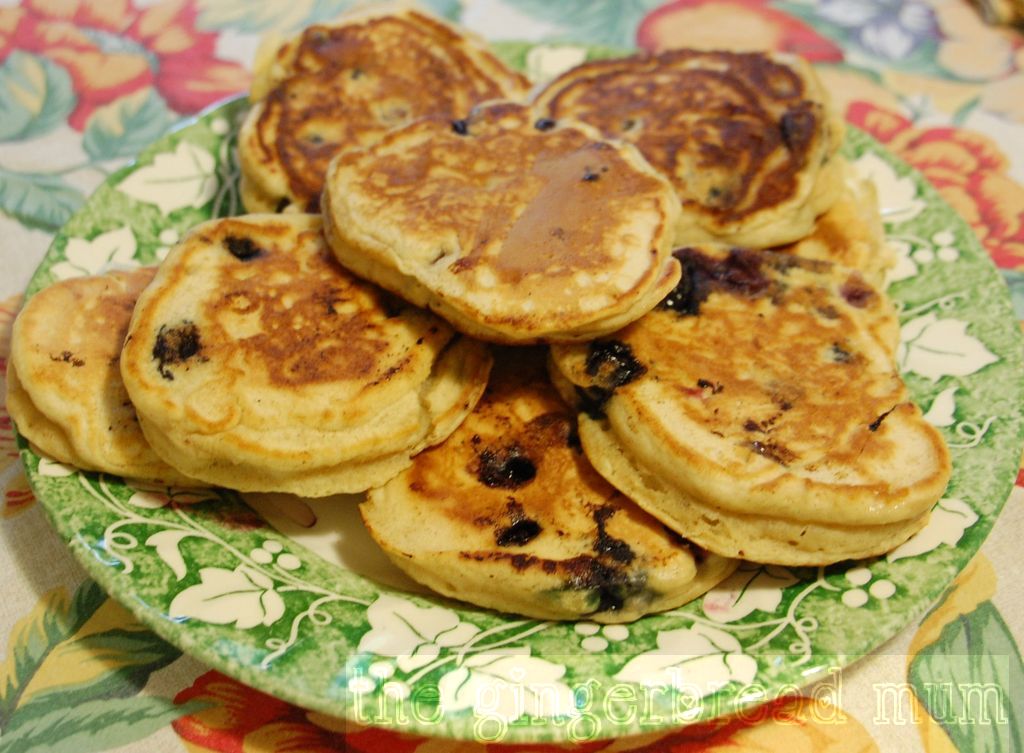
I’m calling these pancakes, probably mini pancakes are a better description, because I left the blueberries whole and therefore made them thicker to surround the berries. Whether you call them pancakes, mini pancakes, pikelets, drop scones or dropped scones, make them, they’re yummy!

BLUEBERRY PANCAKES

Prep time: 5-10 mins
Cook time: 10-15 mins
Makes about 10 mini pancakes
Freezable

1 1/2 cups self-raising flour
1/4 tsp bicarbonate of soda
1/2 tsp ground cinnamon
100g blueberries
1 tbsp honey
1 egg, beaten
1 cup milk
Small piece of butter, melted, to grease the pan

Sift the flour, bicarbonate of soda and cinnamon into a medium- sized bowl.

Add the honey and egg then gradually pour in the milk mixing until you have a fairly thick batter (you might not need to use all the milk).

Gently mix in the blueberries.

Heat a large frying pan over a medium heat and brush with melted butter. Use a tablespoon to drop spoonfuls of mixture into the pan. Cook in batches, turning when bubbles appear on the surface (1-2 mins). Cook the other side until golden brown (about 1 min). Lift out and cover with a clean tea towel to keep warm.

Variations:

  • Use nutmeg or ginger instead of cinnamon
  • Add vanilla essence for more sweetness

Tip: Wipe your pan clean with a piece of paper towel after each batch and then brush with some more melted butter.

Wholemeal wheat thins

One of the food blogs I religiously read is Smitten Kitchen. I love Deb’s laid-back approach to family cooking and the wonderful creations that come out of her small New York kitchen. I particularly love her homemade versions of snacks you might secretly buy at the supermarket checkout.

Her whole wheat goldfish crackers have been on my list of recipes to try for a while, but when her homemade wheat thins popped into my inbox I was running to the kitchen immediately!

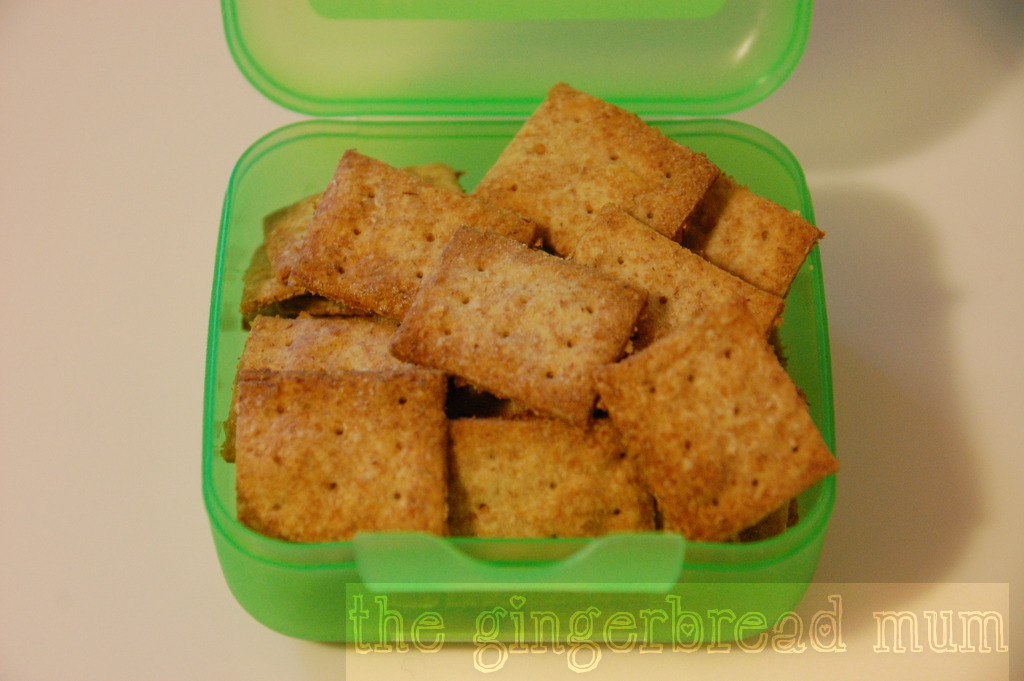
With a food processor you can make these mini crackers super fast (if you don’t have one, follow Deb’s instructions to mix the dough by hand). Most of your preparation time will be rolling and cutting. If you’re a bit short of time, only roll out half of the mixture and keep the rest of the dough in the fridge to make the next day (or even freeze the remaining dough). You don’t need to make the dotted pattern on each cracker, but it does look cute!

I adapted Deb’s recipe slightly. I replaced the sugar with honey. I know, I have this thing against sugar when making things for Nicholas. Actually there’s very little sugar in the original recipe, but I still prefer substituting something a bit more natural and less refined. Honey’s also sweeter so you can use less, and after using it for a while now, I actually prefer its richer more mellow flavour to the harsher stronger taste of refined sugar. Anyway, enough of my honey rant!

As Deb says, you can use white flour and the result will be a lighter texture. I also can’t wait to try these again adding some onion or garlic powder, or some dried herbs. You could also make them cheesy.

I cut my thins smaller, mainly for Nicholas’ tiny hands but also so I wouldn’t feel guilty if a couple of them just happened to find their way into my mouth 😉

WHOLEMEAL WHEAT THINS

Prep time: 15-20 mins
Cook time: 10 mins
Makes about 130
Keep in an airtight container for a week
Freezable (both the cooked thins and the uncooked dough)

1 1/4 cups (155 grams) wholemeal plain flour
1  tbsp honey
1/2 tsp salt
Additional salt for topping (optional)
1/4 tsp paprika
4 tbsp (55 grams) unsalted butter, cut into small cubes
1/4 cup (60ml) cold water

Heat the oven to 200C and line an oven tray with baking paper.

Put the flour, honey, 1/2 tsp salt, paprika and butter into a food processor. Blend the mixture until it’s combined and the butter is evenly disbursed.

With the motor running, slowly pour in the cold water and blend until the mixture comes together into a  ball.

Take the dough out of the processor and divide it in half. Roll out one half of the dough as thin as you can (rolling the dough out over a piece of cling film makes sure it doesn’t stick to your bench and be generous with the flour on your rolling pin). The thinner you can roll it, the crisper your thins will be.

Cut rectangles about 2.5cm by 2cm using a knife, a pastry wheel or even a pizza cutter. Place them close together on your prepared tray and use a skewer or toothpick to poke some dots into each one (I poked three dots from top to bottom on both sides and two dots in the middle). Sprinkle with extra salt, if using.

Bake for 7 – 10 mins until golden brown and crisp (keep a close eye on them as they cook quickly).

Variations:

  • add onion or garlic powder to the mixture
  • add some dried herbs (thyme, sage, rosemary, etc.) to the mixture
  • add some grated cheddar or parmesan to the mixture
  • use white plain flour for a lighter texture

Tip: if your thins start getting soft, pop them back into the oven to crisp up for a couple of minutes.